Showing posts with label Namibia. Show all posts

Wednesday, November 16, 2016

Cape Cross Seal Colony


I've always kind of liked seals. I mean, what's not to like? Their chubby bodies are clearly the best thing you could possibly hug, and they have the most beseeching round eyes ever. But more than anything else, I think they first wormed their way into my heart when I realised that my dog, a barrel-like and highly sedentary Shih Tzu*, bore an uncanny resemblance to a baby seal.


So when Google informed me that the world's largest breeding colony of Cape fur seals can be found on the Skeleton Coast, I immediately knew I had to see it for myself. (I was also highly encouraged by how easy this was going to be. I've gone on whale-watching trips and dive excursions where animal sightings ultimately boiled down to sheer luck. This means that when told there are ten thousand seals doing nothing but lazing perpetually at the same place all year round, there is absolutely no logical reason not to check it out.)


And thus, one grey Friday morning before our flight over the Namib desert, we drove out in search of the colony. It was supposed to be a fairly simple drive - after all there is only one coastal road, and all we had to do was head forty kilometres due north until we bumped into the seals. But life is rarely so straightforward, particularly when you are on a tight schedule. 

After twenty minutes on the road and in the middle of the next sleepy village, our driver pulled up at a slip road beside a tackle shop. 


"We're here," he said, gesturing with his phone, which had an authoritative Google Maps pin in the centre of the screen. 

A good number of unanswered questions ran through my mind as we stepped hesitantly out of the car. Why is it so quiet? Are they not wild seals? God forbid, did the seals pull a mass migration just before we came? And why is there a palatial Chinese restaurant across the road anyway? (The correct response to the last question is always: Because we really are everywhere. But in this case the response was also: There are a lot of Chinese miners extracting uranium in this part of the country.)


One puzzled phone call later, the driver grinned sheepishly and told us we were about twenty kilometres off track. It took another fifteen minutes of driving through the desert before the first weathered sign saying Cape Cross Seal Colony came into view.

By this time, a gale was picking up and dark clouds were gathering at the far edge of the desert. And perhaps it was because of the wind, but we certainly didn't smell or hear what ten thousand socialising animals should smell or sound like. In fact, we couldn't even see them, though a car going the opposite direction assured us that they were just ahead.


It was only after we went up a short rise and turned into the parking lot that we came face-to-face with the first seal - a rambunctious fella who was lying across the base of a plaque, and who told off our driver in no uncertain terms when he leaned in too close for a selfie.

Beyond him the parking lot opened up into bare rock. Not that you could see much of the rock anyway, because - yes - the ten thousand seals! 


There they were, in a multitude of sizes, some fighting and some sleeping, and yet others making their way into the cold Atlantic waters, where there was an endless display of acrobatic backflips and wave-surfing going on. The scene was cooler than I could've imagined, if only because I'd never seen so many animals congregated in one spot before. The only thing that took me by surprise was, in spite of how cute they look, how remarkably (and horrifically) cow-like they sounded. And make no mistake, I'm not talking about the kind of cows you see on telly in some idyllic milkmaid advertisement. These ones sounded like cows on a rampage. It was all bellows and bovine shrieks, and the occasional hacking cough of an old man with an incurable lung disease.

Also, for an animal so big, they were surprisingly timid. At one point of time my dad took off his cap and waved it at me to get my attention. I didn't notice it, but the seals around my dad certainly did - about thirty of them bolted upright and shuffled away at top speed.

Regrettably, we didn't get to spend more than an hour wandering amongst them, as we had to rush off for our flightseeing tour. We did end up seeing a number of seal colonies from the air that day though, but none that came anywhere close to the size of the Cape Cross one.


*Speaking of which, I went to a zoo the other day and there was only one animal - a dog - in it. It was undoubtedly the worst zoo I'd ever been to. On the way out, I grabbed the zookeeper and asked why there was only one dog. He said, "Because it's a Shih Tzu."

Thursday, October 06, 2016

Over the Namib Desert


On our last proper day in Namibia, we went for a flight tour over the Namib Desert and Skeleton Coast. The plane was due to take off from an airport on the outskirts of a small seaside town called Swakopmund. 

The night before we had arrived fresh off a three-day trip into the desert (which by the way is probably one of the best experiences of my life if only because of the view of the stars at night), and had checked into a hotel that turned out to be little more than a row of containers. The interior was, shall we say, minimalist – although frankly what little furnishing they had was a huge luxury compared to the tents and sleeping bags we had been using for the rest of the trip. To top it off, we had discovered a restaurant with an amazing seafood curry that unequivocally put the ham sandwiches we’d had for three meals a day the past six days to shame. 


The restaurant was built around a real tug boat overlooking the Atlantic Ocean. When we arrived it was just past nine at night. It was dark out – the only lights around were those of the restaurant and the hazy, flickering embers of a dozen lit cigarettes in the hands of lovers on the beach. The dazzling night sky I’d become so accustomed to in the desert was completely shrouded by the heavy fog and opaque clouds that had swept in from the ocean. Yet, through the dress of white, you could still hear the ocean’s ceaseless, timeless rhythm breaking along the nearly invisible coast. 

The fog was to persist till the morning of the day our flight was scheduled to take off. At eight in the morning, the flight operator called to inform us that there was a good chance the flight would be cancelled given the poor weather conditions. “No flights yesterday and the day before,” she said, “The conditions just won’t allow it. Let’s wait and see.” 


Miraculously, half an hour before our scheduled take-off, the fog lifted and the skies cleared. It was to stay clear right up to the time we touched back down on the runway, a window of almost exactly two hours. In effect we were the only flight to have made it out in three days. 

What luck, and what an experience! I’d thought it would be terrifying to be in such a small plane – they look almost toy-like and capable of getting blown off-course at the slightest cross-wind. But something about being able to see exactly what the pilot is doing (i.e. looking utterly calm and unconcerned) was very reassuring. 

 -- 


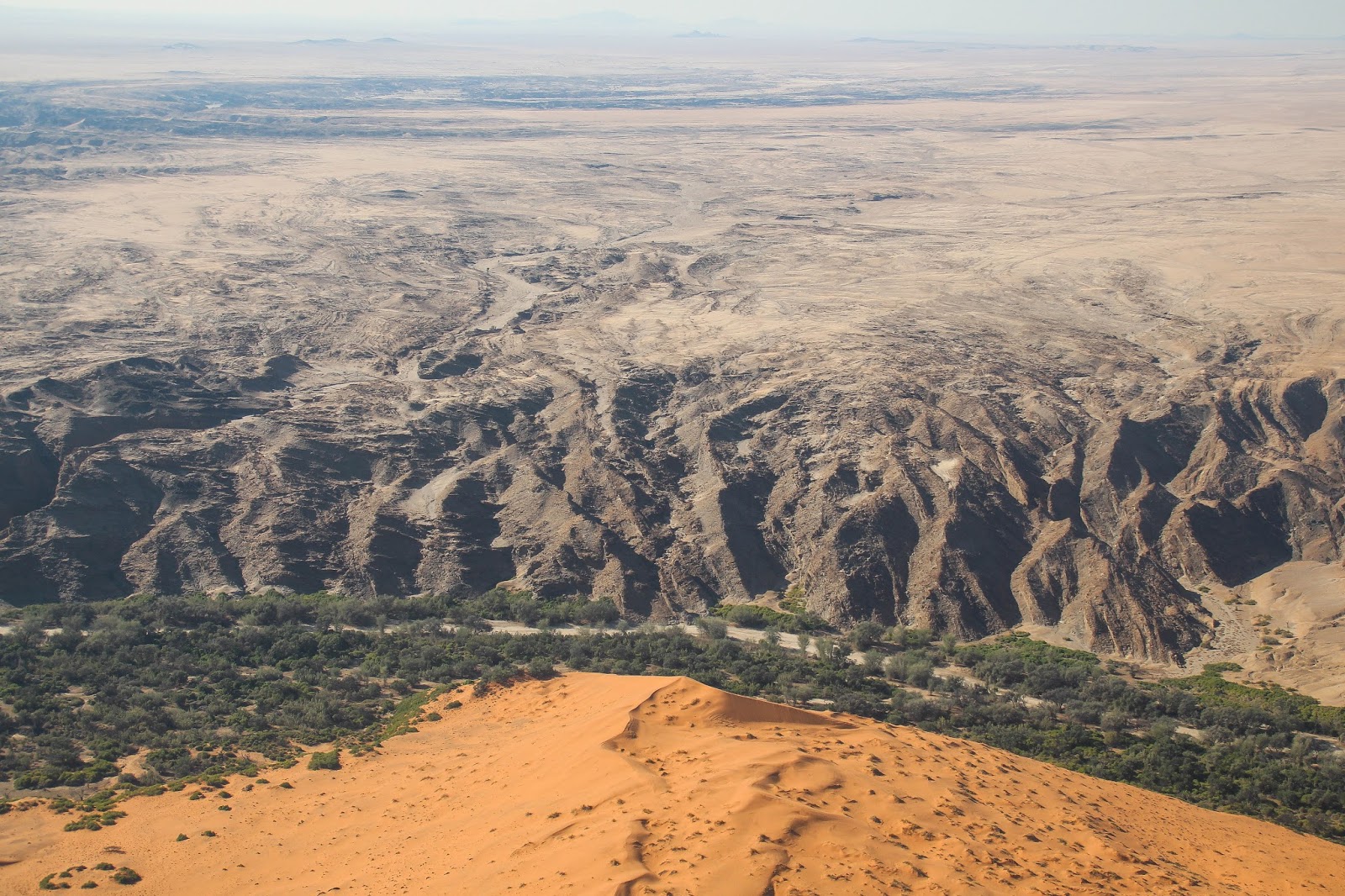
The first hour or so we fly in a roughly straight line over the desert. From this vantage point it isn’t always possible to make out the undulations of the sands beneath us, particularly because the noon-time sun is at its apex and there aren’t a lot of shadows to throw the dunes in relief. But the lines that are ridges of the dunes crisscross each other in a satisfyingly abstract way, at times in a confluence of whorls, other times in stark perpendicular edges, and yet others in beautiful snaking patterns. 


Then there is the spectrum of colours – from the red, iron-rich sands that blow in from the Kalahari Desert, to the muted beige that stretches endlessly in all directions, to the golden dunes that fall abruptly into the Atlantic. At one point a vivid furrow of green, so out of place in this barren landscape, comes into view. It neatly demarcates two distinct environments: a vast granite plain on the left, and dunes of red on the right. We meander along the belt for a while as the pilot yells to us over the roar of the propellers, “The trees follow an underground river!” And indeed, far below, we can see this unexpected oasis of life wind its riverine way into the distance – leading, I imagine perhaps overly romantically, to a lost jungle paradise – as we reluctantly break off and veer towards the coast. 


Before we see the Atlantic Ocean we see the shipwrecks. They languish in eerie abandon, their once proud features now skeletal and weathered a rusty brown. The wrecks are so far inland because the desert constantly pushes its way into the Atlantic, so year by year the ocean slowly loses its grasp on its ill-fated victims. 

Now we are flying along Skeleton Coast. The contrast – of colour and movement – between the desert and the ocean is equal parts stunning and haunting in its desolation. It’s impossible to be here and not realize how large the world is, and just how small we are in the grand scheme of time and space. 


It's ninety minutes into our flight. Before we arrive back at Swakopmund, there are a few more treats for us: pockets of Cape fur seals lounging on the beach, an inlet bordered by pink flamingoes, and a flock that motors by some ways beneath us. 

-- 

Then, all too soon, the flight ended and we descended back into the encroaching fog. As we taxied down the runway the world behind us gradually disappeared into dreary whiteness, and it felt uncannily like waking up from a lucid dream. Only this time, we knew it was real, and as I type this on my laptop, I smile at the thought of this spectacular realm of wildness that endures its way through the ages, somewhere across the globe from where I am right now.


Wednesday, October 05, 2016

Deadvlei, Namibia


We are explorers.

Hands held high against our brows, shading our faces from the relentless heat - a futile resistance. We trudge steadfastly into the rising sun.

Ahead of us the desert unfurls like a roughened red ribbon. We stand in the hollow of its creases, where its edges are out of sight, but we see in our mind's eye that it ravels till the ends of the earth and know there is no one here but us.


A sand dune lies in our path and we decide: we must climb. Step by step we ascend, bent over in effort, up a red wall that falls silently away beneath our feet. Along the ridge the wind whips ripples into the sand and raises a cloud that hangs in the air and assaults our breaths. We tumble gleefully down the far side.

Here, a dry riverbed. It is old, cracked, and bleached the colour of time. We follow the fossilised tracks of an antelope and then a hyena. The idea of life in this most desolate of lands is inconceivable. We laugh, giddy, as the sun's rays beat down mercilessly on our shoulders.


Another sand dune, and another, and a shimmering mirage of an oasis in the distance. We can see the harsh outline of trees standing tall in a chalky white lake. Drawn by the hope of respite, we inch closer. But it is not water, and there is no rest. Instead: gnarled outstretched limbs, immovable in a bed of clay, twisted and frozen in an image of death -

Deadvlei.


--

Deadvlei is a clay pan characterised by the dead trees that still stand in it, a remnant of lusher times when a river flowed through the area. As the climate changed and the sand dunes shifted, the river was diverted and eventually dried up. The trees died soon after due to the lack of water but never decomposed because of the dry heat of the desert. Seven hundred years later today, they have become one of the most recognisable symbols of the Namib Desert.

Also, the massive sand dune in the background is called Big Daddy, and it's said to be the highest sand dune in the world at over three hundred metres tall. 

Saturday, August 27, 2016

Safari at Etosha National Park, Namibia

The journey to Etosha National Park from the capital city Windhoek was smooth until the back tire on our eight-wheeler unexpectedly blew halfway through. Changing it took the better part of two hours, which was a long time given the short winter days. At first we were tense, eager to regain momentum so we could make it to the park before nightfall, but after the first hour the anxiety gave way to acceptance. That's life after all, having to take everything in stride and dealing with it the best you can - and there's no better way to come to that realisation than under the unrelenting African sun.


We made it to the gates of Etosha fifteen minutes before the sun disappeared over the horizon, so my first memory of the savannah is tinged with a resplendent orange glow. In that glow, silhouetted against the setting sun, is a lone elephant - he's not grazing, just standing motionless in the tall grass, and as we draw closer he looks at us momentarily then slowly turns away.


It's like Etosha's gates separate two disparate worlds. Outside, the land is mostly fenced up game ranches and farms, bisected by a single long road where you can drive for hours without seeing life, though there is no lack of discarded water bottles and cigarette butts littering the rest stops. But beyond the gates the asphalt abruptly turns to gravel and the fences disappear. The plains on both sides of the track are so vast and unsullied, and dotted with so many different species of animals, that you can't help but feel you've been transported back in time. This, I think to myself, must be what the world looked like long before Man arrived. 


A few hundred metres from the entrance, someone gives a great shout. Elephants! We screech to a halt as a herd emerges from the trees and crosses the road (they didn't look both ways). They've almost all reached the other side, but big mama pauses and looks back, and a little one comes scampering out of the bush, ears flapping as he races to catch up with the herd. 


Such beautiful animals, elephants - and we were lucky to see over a hundred during the safari, with the biggest sighting at fifty-four in a single herd. Up north, we were startled to see two big white males, but it turned out that the colour was just due to the mud they use to coat their skin for protection against sunburn, which was chalkier than the one their southern neighbours use. Watching the elephants interact, there's no doubt that they're intelligent social animals. When they meet up, they always touch each other with their trunks in greeting. They also wait for their slower members, and you can tell the younger ones are having fun splashing about at the waterholes. 


Giraffes, on the other hand, are kind of funny. They freeze in place when they spot you, although their heads turn and track you as you go by. The exception to the rule was this one baby giraffe who tried to get as far away from us as he could, his legs flailing in all directions as he broke into a run that could barely keep pace with his mother's slow stride.


There's also the kudu, a type of antelope with the most graceful, curvy horns. You can tell whether the kudu is a mature one by counting the number of curves in them - there are four in the horns of adults. And then there's the oryx, whose face looks like some kind of kabuki mask. One loiterer at the doorway of the campground shower gave me a shock when I stepped out, still bleary from the cold morning temperatures. At night we also saw some bad-tempered rhinos at the waterhole, who tried to instigate fights with each other and the elephants.


The reason why there there are so many animals in Etosha (although no Cape buffalo, the only one of the Big Five not found in Namibia), our guide explained, was because the authorities actively rounded up the animals that lived outside and relocated them in. It's as much for their own protection as it is for the farmers. As Namibia's population grows and farming activities increasingly encroach on the animals' territories, the number of conflicts between humans and animals rise as well. This is especially true with predators - the lions and leopards - who find easy meals in the farmed livestock. 


I won't forget our first encounter with the lions. Dad woke me up at two in the morning, face flushed, saying, I can hear them! He had been on his way to the washroom when suddenly, from somewhere beyond the edges of the facility, he had heard the unmistakable low throaty vocalisations of a patrolling lion. He hurried back to our tent where we sat and listened to the noises make a slow round along the periphery of our camp ground. I wanted to head down to the waterhole for a quick look-around (there's a viewing area that's protected), but prudence in the form of my Dad intervened, and we decided to stay in the tent instead. (I'm not sure how much protection the tent fabric would provide against a marauding lion intent on a meal, but in any case we took some solace in it and went back to sleep. Anyway, I jest - Okaukeujo Camp is a perfectly safe place; the only thing you are in danger of is having your socks stolen by jackals at night. They have the most annoying tendency of only taking one side.) 


The next morning, as we drove out of the camp grounds, a fellow safari-goer waved us over. Lions, he said, five hundred metres ahead. You can imagine we didn't waste any time in making our way there.


We found the pair, a male and female, without any difficulty. At first they kept their distance. One in front of the other, they weaved along the boundary between the plains and the thicket, occasionally disappearing behind dense patches of dry woodland, only to re-emerge silently seconds later. Slowly, leisurely, they got nearer and nearer to us. Through my camera's lens I could see their yellow eyes and the scars that formed dark shadows across the lion's face. (I gave myself a heart attack when the lions suddenly looked too closely for comfort - before remembering quite shamefully that I was observing them through my maxed-out zoom lens.) The pair ended up passing us less than three metres away, and when they did, they gave no sign that they even saw or cared that we were there, before stalking off into the endless horizons of Namibia.


There were also multiple encounters with cheetahs, including three adolescents hiding from the sun under a tree. Then, on the last day, we saw a leopard. We were already on our way out of the park when we stopped to take a last look at a pair of giraffes, partly because of a small group of impala that was obstructing the road ahead. No one paid them much heed in favour of the giraffes that were doing their usual comic impression of a lamppost. Then someone turned back to the impala and noticed that in the span of thirty seconds, a shadowy figure had appeared and was sitting behind the impala. The guide grabbed my binoculars urgently. We go now, he said, there's a leopard hunting the impala.


We had barely made any ground when suddenly the impala broke into a run, dashing into the cover of the shrubs on the opposite side of the road. In a split second the leopard was up and running as well, merging into the dappled brush after its prey. Through the gaps in the foliage we made out the shadows darting by -  first the frantic gait of the hunted, then the fluid movements of a larger silhouette. We don't know if he caught up, but what a high-energy end to our safari! And, funnily enough, we would never have seen the leopard if our tire hadn't blown again in the morning and delayed our departure. Talk about things coming a full circle - and maybe that's an apt metaphor to round up our first safari experience with. :)


Saturday, June 18, 2016

Skeleton Coast, Namibia


Namibia. Home to one of the world's least known genocides, a country bordered along the wild Atlantic ocean by an endless, inescapable swath of golden sand. Year by year this unrelenting desert pushes into the ocean, slowly staking its claim - the result is a series of shipwrecks stranded fifty metres inland, once, I imagine, bustling microcosms of activity, now skeletal and rotting away into the dust, one day to become indistinguishable from the sands that roil by and unfold into the horizon. These, together with the bleached, weathered bones of their human survivors, who had tried in vain to cross this most inhospitable barrier, gave rise to its present-day name: Skeleton Coast.


To be sure, the Namibia I see today - impeccably clean, full of continental cars on streets named after famous Dutch and German figures - came to be in part due to the Germans' presence. But cultivating a beautiful city is not the point of establishing a colony; there is inevitably something of greater mercenary interest to be exploited for the good of the empire. In this case, it was Germany's fatal attraction to its treasure trove of diamonds and slaves.

Unknown to the indigenous people who lived within the lush interior of Namibia, the land itself had been resisting the colonists for centuries. Since the 1400's, the Portuguese, British and Germans had tried in turn to enter via the Atlantic. But the thousand-mile long and hundred-mile wide Skeleton Coast proved to be impenetrable. The Nama and the Herero were insulated - for now.

Then, in 1883, a young German sailor landed on the shores of Angra Pequena. Angra Pequena was a small cove with just one permanent building, which belonged to an English trader who made his living selling oils he extracted from the livers of cat sharks. The cat shark was an animal profuse in the waters around Angra Pequena, particularly at a long narrow island just outside the bay. Fittingly, this was called Shark Island. It was later to become home to the world's first extermination-cum-concentration camp - and its fate, together with that of the thousands destined to die on its rocky shores, was sealed when the German sailor successfully struck a deal with a local chief for Angra Penquena and five miles of land surrounding it. The hoisting of the German flag over this desolate harbour, now renamed Lüderitz, represented Germany's first inroads to its African empire.


Over the next twenty years, four men from varying military backgrounds were dispatched to Namibia in succession to establish a German colony. The first of them was Heinrich Göring, whose last name must immediately be familiar to all of us today. We know it because it belonged to the President of the Reichtag, Hermann Göring, infamous for being the one who ordered the "Final Solution" against the Jews to be carried out in 1941. Heinrich Göring was his father. In retrospect, this was a dark foreshadow of what was to befall Namibia in later years.

1904 was a turning point in local history. General von Trotha arrived in Namibia, sent specially by the Kaiser back in Germany to quash a Nama and Herero revolt, which had arose due to anger and frustration accumulated from years of abuse. Von Trotha's response was swift and merciless. Not long after assuming power, he ordered an annihilation of the Nama and Herero, killing up to five thousand of them in direct battle and driving thousands more, including women, children and the elderly, into the desert. Scores of them succumbed to the desert heat, in some cases after resorting to drinking cows' blood as a last resort against thirst.


In the immediate aftermath of the battle, von Trotha issued a proclamation against the Herero. It stated that all Herero were to leave the land or face execution. This order, however, was rescinded because the German leaders back home saw the Herero as an economically viable source of labour, and at the end of 1904, a new order was given to herd the Herero into concentration camps. 

At the same time, a new wave of academia was making its rounds in Germany. Called eugenics, it was centered on a set of practices and beliefs aimed at improving the genetic quality of the human race. Its biggest advocate was Eugen Fischer, and he propounded his theories by conducting medical experiments on the Herero prisoners in the concentration camps. His claims were later to form the cornerstone of Hitler's Aryan movement during World War II. 


--

Today, flying over Skeleton Coast, it's not at all apparent the history these lands have seen. From this distance the undulating patterns look stoic - it's easy to lose yourself here in both time and space. I close my eyes for a second and imagine myself stepping foot ashore and facing these immortal sand dunes. What sheer desolation and desperation one must feel! 

We pass over a collection of half-collapsed beams in the middle of nowhere, and the pilot dips his wings at them. Diamond camps, he yells over the roar of the propellers. Once upon a time, this desert held one of the largest surface deposits of diamonds; early German colonisers simply walked the plains and picked up diamonds glinting in the sun. Today these are long gone. Instead, it is the remains of the genocide victims that now lie interred at the outskirts of Swakopmund, a seaside resort town on Skeleton Coast. By some estimates a hundred thousand people were killed in those tumultuous years. Yet their stories are forgotten, their voices silenced and buried as if by the immense bleakness of this godforsaken desert. There are no memorials for the Nama and Herero (although there is one for the Germans in the capital city Windhoek), and even the locals side-step the issue almost apologetically. And as I cross Bismarck Strasse into Strand Strasse, I can't quite suppress the bubble of heaviness that wells up and out of me, floating down this little picture perfect street and into the sea fog that lingers at the edge of my periphery.


Source: The Kaiser's Holocaust: Germany's Forgotten Genocide