Showing posts with label Ethiopia. Show all posts

Sunday, December 03, 2017

Dallol


Stepping into Dallol is like stepping into another world; there's no less cliched way to say it. Where else could the very fabric of a place be such a kaleidoscopic clash of colours, lines, and patterns? It is the masterpiece of a painter taken by fever, or the enigmatic translation of a three-year-old's dreams onto canvas; this is the only fitting description.


Even its name hints at how far removed it is from our understanding of normality. Dallol - or, in English, disintegrated. Broken, not intact, not one of the whole. I wonder how the first few persons who stumbled onto this place felt?


The landscape is all the more alien because of the journey we took to get here, across the vast salt pan that separates Dallol from the familiar. We drove steadily across the blank whiteness of the pan, until a rusty-brown mound that rose abruptly out of the flatness prevented us from going any further. The mound was torn by thigh-deep rifts that we often had to skip over, or if they were too wide, retrace our steps and avoid.


And now, here we stand: on the highest point for miles around, looking down on a psychedelic shock that shouldn't be, but is.


Dallol, being a volcanic crater, is an area of sulfur. Although maybe it is the weather, or some other unknown reason, but the air isn't sharp with the acrid stink of sulfur; Dallol is merely an assault on the eyes today. In places the pools of blue and green catch the sunlight and glint in a faintly translucent way - I think like how a painter's workspace must look like, with countless containers of multi-coloured paintbrush water pushed together haphazardly. But this is just an illusion; closer inspection reveals that the surface is solid, crystalline. Still, we take heed as we navigate around the crater on the narrow whitish crusts, for the faint bubbling noise reminds us that under the layer of crystals, there is a nasty surprise in store for the careless.


Thursday, July 13, 2017

Of salt flats and camel caravans


Most people would have probably heard of the salt flats in Bolivia, Salar de Uyuni. There are tons of gorgeous photos of the place - vast expanses of white in the dry season, and perfectly mirrored shots of the sky in the wet season. But I don't think many have heard of the salt flats in northern Ethiopia, despite its no less impressive claim to fame.


The salt flats lie in Ethiopia's Danakil Depression, one of the lowest (a hundred and twenty-one metres below sea level, certainly the lowest point in Africa) and hottest places on Earth (though you wouldn't know it from my photos, because of the unseasonal torrential rain that had flooded the area in a single morning. And speaking of which, has any one else noticed that unseasonal weather is becoming more and more frequent? I've had four consecutive trips where we met weather patterns that had the locals mystified - unexpectedly grey weather in French Polynesia; extended droughts in one part of Ethiopia and unusually heavy rains in another; late spring in Yubeng; and sandstorms in Jiayuguan. We even heard that the hammerheads we'd encountered in Indonesia in 2015 had gone deeper this past season because the waters were getting too warm for their liking). Temperatures go up to a mind-blowing fifty degrees Celcius from June to August - the only months when the salt miners take a break from plying their time-tested trade, one that has seen generations and generations of miners come and go, for over two thousand five hundred years. In spite of its already long history, there's little doubt that this trade will continue for many more years, because the salt flat is one thousand two hundred square kilometres and - get this - eight hundred metres deep.


We had actually been on our way to a sulfur mine, which lay over an hour's drive beyond the salt flats. Behind us was the salt miners' camp, a derelict settlement of shabby huts and indiscriminate piles of rubbish, and far beyond even that was a village built on the edge of a dried-up river. Miners have to walk about two hundred and thirty kilometres with their camel caravans to reach this village in order to sell their salt. 

Later that night we would return to the miners' camp to rest - we slept in huts whose roofs and walls offered little protection from the rain, and conducted all manners of business in the open (there was no purpose-built toilet). Besides the obvious squeamishness of accidentally stepping in someone's leftovers, the thing that struck me the most was the sombre thought of the locals who fall ill, some perhaps fatally so, from the unhygienic living conditions - and I, lucky me, just for being born in the right place!, was safe from all these diseases simply because I had cheap and easy access to vaccines in my own country. The unfairness of the way the world works boggles my mind.


In any case we were now in a convoy of jeeps travelling over the salt flats. Because the rain had made the ground dangerously slick, our driver was going at a very cautious ten km per hour - at one point I wasn't sure if he was feigning sleep or had really nodded off. We continued this way for what felt like an hour before finally reaching a dry patch, where we stopped for a quick stretch and a marvel at the scenery. And the scenery, it must be said, was pretty cool - all around us were these distinct, three-dimensional hexagonal tiles on the ground, forming an ancient geometric tract that was once upon a time part of the Red Sea. 


Then, further down the salt flat, we met a large congregation of miners. They were hunched over in groups of three or four, their donkeys and camels lying by their sides. Given the number of people the area was oddly silent, save for the rhythmic chuf chuf chuf of hoes cutting through the salt. Even the animals had a strange sort of impassivity to them; I imagined that they were despondent from the heat and tedium as well.

The miners were each engaged in different activities. Some of them were hacking rough chunks of salt from the ground, and the others, whittling them down to equal-sized slabs. Yet others were busy lashing the slabs onto their camels, readying themselves for the long walk back to camp before nightfall.


It's not easy work, as you can imagine -

Your palms and soles, raw from the jagged crystals that make up your lifeblood.

Your eyes, perpetually narrowed against the glare of the surrounding whiteness.

Your skin, burning from the feverish, salty African sun.

Your back, hunched over for hours on end, as you chop chop chop away at the ground beneath your feet.

One miner looked up at us as we went by. He could speak Arabic because he'd worked in the Middle East before, he said, was there anyone here who could understand him? An Egyptian man in our group stepped forward. Someone else handed him a bottle of water, which he acknowledged, and then he asked in a quiet, matter-of-fact way through the Egyptian, "Do you have painkillers?"


Thursday, June 01, 2017

Omo Valley, Ethiopia


At the tail-end of our trip to Ethiopia, we visited the Omo Valley tribes in the deep south. Thinking back, I'm not sure what I had expected to get out of that sojourn. Barely a week after my trip a friend back in Singapore described it as akin to a frivolous gap year - that is, by his definition, the kind of self-gratifying trip that privileged kids take to ogle at the less fortunate. I argued weakly that I wasn't there to feel better about myself, but it was true that I had specifically chosen to visit the tribes because they seemed so exotic -  so, ogling, if you will.

Incidentally, this was the first time I'd decided to visit a group of locals for the sake of finding out more about their way of life. Usually my trips are centered around hiking and diving; if the chance came up to interact with the locals I'd seize it, but it had never been something I actively sought out. So, it wasn't until I was on the jeep headed towards the Mursi tribe that it struck me I didn't have a clue what to expect when I finally met them. Would we be invited in for tea and a chit chat? Maybe they'd take us for a walk around their village. Or perhaps we'd luck out and there would be a celebration that we could take part in. Regardless of how it could pan out, I wasn't certain how should I conduct myself to ensure that I would be respectful and non-intrusive, because I imagine there are few things worse than being objectified and looked down upon.

*


It must be said here that Ethiopia is not an easy place to love. From the moment I touched down in Addis Ababa and was bodily pushed out of the airport door by a security guard, my impression of the country took a downturn. Then, as we travelled out to northeastern Ethiopia, the land became more strewn with rubbish and the people increasingly aggressive. Children threw rocks at us. A boy barely ten years of age threatened to slit our throats with a machete. Two men bigger than me smilingly asked me to take a photo of them, then grabbed my arm and demanded payment for it. A toddler threw a stick at our car with so much vehemence that his feet lifted off the ground. People of all ages yelled "China, China!" at us. We were heckled, shoved, and had our personal space invaded countless times (though it was sometimes out of curiosity and not maliciousness).

At first I was really upset. These people and their actions affected me and made me feel constantly on edge. Who likes to be treated with this little respect, consideration and dignity? Then, one day, our guide sensed the mood and told us: Don't worry. Do whatever you want. If you want to take pictures or walk around the village, but they shout and throw rocks at you, ignore them. They are nothing.

His words gave me a jolt. In an instant, I understood why and how these people came to act the way they do. How can these people be expected to treat others with respect when they aren't accorded the same, not even by their own countrymen?


I also realised that I wasn't enjoying the trip because I was reacting to the situations without first seeking to understand it. The region I was in where most of these incidents happened was Afar, one of the poorest in the country. Ethiopia, though developing better in recent years, has also been through some tough times. Wars, politics and famines have ravaged the country; its scars are obvious to see. There are people begging on the streets for money. As you get further out from the capital the requests become for food, then water. We even visited a tribe that lives in abject poverty, in an area so parched and primitive I could barely believe it exists. To exacerbate the situation, there was a drought going on while I was there, and so there were a lot of people in desperate conditions. Recognising these facts made me empathise with the people who were rough towards me, instead of instinctively shunning away from them out of fear.

We are all moulded by personal circumstances, and we all struggle to survive the only way we know - some more so than others - and perhaps, at the end of the day, the best we can do is to recognise each other as children under the same heavens, and appreciate just how far a little kindness can go.

*


The first tribe we visited was the Mursi (famed for the clay disks the women wear in their lower lip). They lived about sixty kilometres from the town of Jinka, and we made the journey by four-wheeled drive, bouncing down dirt roads heavy with suffocating clouds of hot dust. The arid land stretched out to the horizon on both sides, dotted only with the withered outlines of dead trees, and tall, bizarre-looking termite nests that were surprisingly cool to the touch. The ride took us over two dry riverbeds. I looked out the window in time to see three dead cows, their hides waxy and stretched tight over their protruding ribs. (Cows and goats are the lifeblood of the tribes here, and this must have been a significant loss to a family out there. To illustrate how important the animals are: during one of our drives, we met a roadblock; villagers standing sentry at the sides of the road ran out, dragging large tree branches that they laid across the path of every approaching car. Twenty or so men and women brandishing all manners of weapons - machetes, sticks, stones - then poured onto the road and surrounded each vehicle. It turned out that a truck had hit a goat further up the road, and the owner had made a quick phone call to mobilise a roadblock on all vehicles passing through. With some persuasive skills and a good deal of cold sweat, our driver pointed out that we weren't the persons they were looking for, and they cleared the road for us to go on.)

At the edge of a slight clearing, our car stopped. There wasn't any real indication that we had arrived at a village, but we got out of the car anyway at the behest of our driver. Almost immediately, a couple of children with white paint down their torsos came skipping out from behind a nearby grove of shrubs, chorusing the phrase we would come to realise was the anthem of all youths in the Valley: Photo, photo, ten birr, ten birr! A group of bare-breasted, middle-aged women soon appeared - the men were out tending to their livestock, so only women and children were around - their calls of ten birr were only slightly less energetic than the children's.


Our driver took us on a tour of the village. I use the word village loosely, because it supposes a certain size, and this community consisted only of fewer than ten huts, each shaped something like an upside-down jello cup. It took all of a minute to walk around it. All the while, a train of Mursi followed us, tugging on our shirt sleeves and trousers - and my ponytail - repeating "photo, photo," until even our driver looked at us wearily and shrugged. "Photo?" he asked.

That was the magic word; immediately the Mursi gathered into a rough line, pulled their clothes straight, and put on their head gear. They beckoned with their hands at the slightest eye contact, mouthing photo, ten birr, ten birr, in a whispered urge that knew the visitors would surely pay for photos, after having travelled all this way to see them.

How it goes is this: from the people standing in front of you, you choose the ones that catch your eye. It could be the one with the most flamboyant headwear, or the one with the most impressive scars. Or maybe it's the kids who have painted themselves in an identical fashion and are standing with their arms draped over each other's shoulders. Kids are always cute in photos. Having chosen your subject, you then point to them and gesture with your camera, and mime where you would like them to stand or pose. Usually, they already know the good spots and the popular poses. They wait patiently while you fiddle with your camera settings and check the image preview. You snap, snap, snap, then hand over a handful of crumpled notes.

Let me say it here - that was easily the most uncomfortable moment of my trip.

Reeling a little from the shock of it, I took a handful of photos mindlessly and signalled to our driver, let's go. He gave me a look of amusement and turned to lead the way back to the car, whereupon the rest of the Mursi broke rank and started surrounding us again.

In retrospect, isn't this ironic? There I was, worried that I would be objectifying the tribes-people and intruding into their personal space, but as it turned out we were the ones getting harried instead. Fair exchange, I say. We get a brief glimpse of their lives, and they get to capitalise on our curiosity. In regions rife with poverty, this has turned out to be smart, opportunistic way to get money for food and medicine.


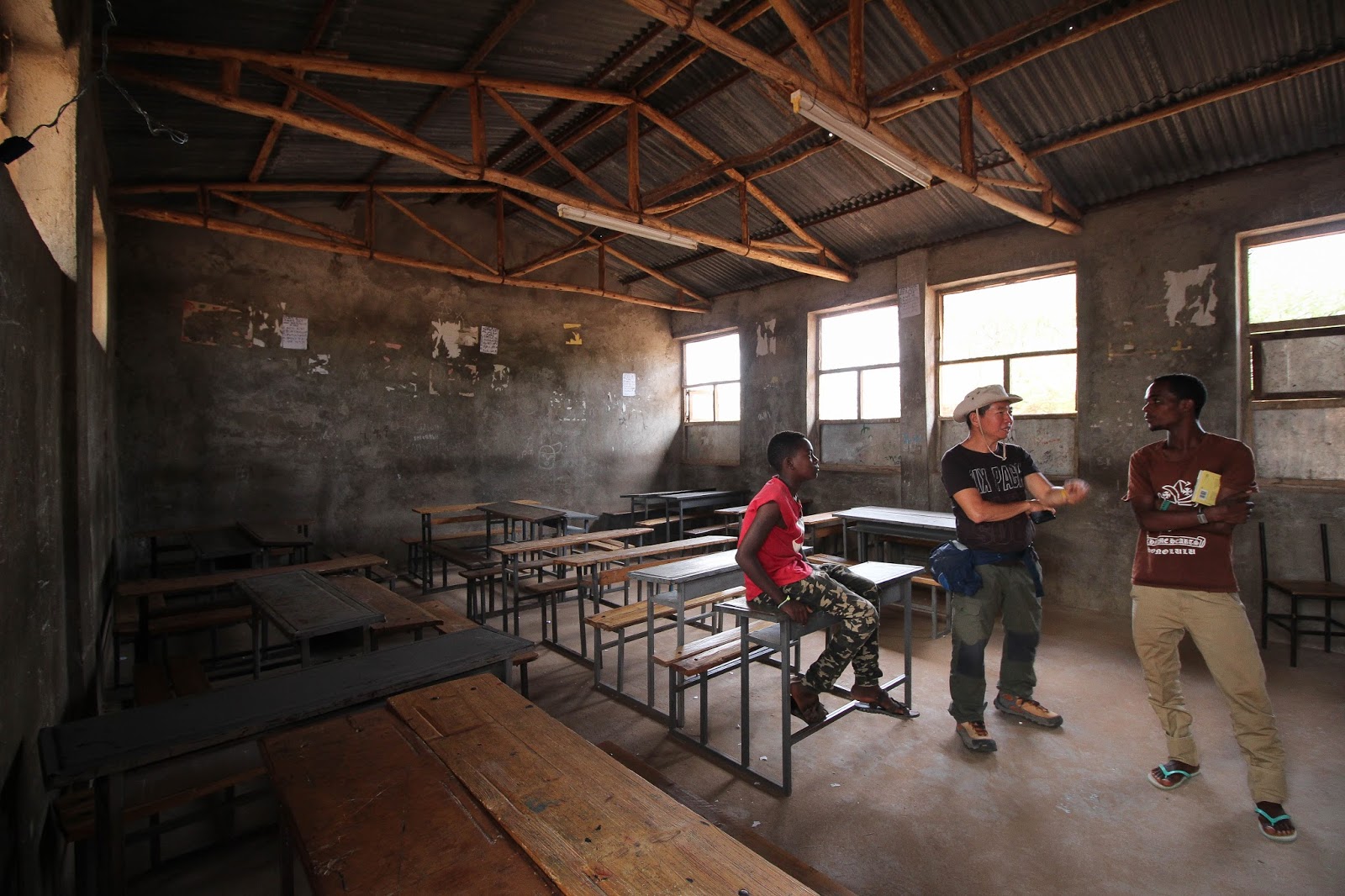
After the Mursi, we headed back to Jinka, where we met up with the principal and two students of a local elementary-cum-high school. We had with us a fairly large number of English books - courtesy of many generous friends - that we intended to pass to the school, since these aren't that easy to come by in the smaller towns. One of the students was a nineteen year-old boy in Grade Eight. He told us that he'd only enrolled at age thirteen, because his family had been reluctant to lose a pair of helping hands around the farm. His dream now was to make it to university one day, and the last glimpse I caught of him running down the street with an Enid Blyton book tucked under an arm will always be a reminder of what it means to persevere against all odds.


From Jinka, we headed deeper into the Valley, visiting the Hamar, the Bena, the Tsemay, and the Daasanach. By this time Dad and I had gotten a lot less awkward interacting with the tribes-people, although that didn't detract from the fact that every photo and conversation was transactional. Mostly, I was the one who was the target of the badgering because my camera gave me away. Dad conveniently deflected all attention from himself by automatically saying, "She's the one with the camera, go ask her." He was, however, outwitted on one occasion when an enterprising young lady came up from behind and pushed her bare chest into his arm. When he recoiled in surprise, she grinned sheepishly and seized the temporary attention to parrot, photo, photo! 


Thinking back, the most peaceful moment I had that leg of the trip was when we were on our way back to Arba Minch. We had pulled over at the side of a road to wait for the local police to come by with some paperwork. The sun was low in the sky - I can't remember if it was rising or setting - and the terraced hills of Konso were cast in a hazy glow. There was no one for miles around - or at least there was no one interested in us for miles around. I stood on top of a small hill in the unexpected quiet enjoying the view, until our driver waved me back into the car, the faint sour odor of butter (that the locals mix with clay and rub into their hair) lingering in our senses long after the scenes of the Valley had faded away.


Saturday, April 29, 2017

Snapshots of Lalibela

Saint George's Church in Lalibela (shaped as a giant cross) is carved 15 metres into the ground

Lalibela is set in the craggy highlands of northern Ethiopia. The overland journey there will take you past scenes frozen in history - huts woven together with sticks, bare-chested children playing under the trees, and farmers bent over in terraces of teff. Elders shrouded in white, timeless apparitions that have been treading these roads for centuries, pause in their tracks and gaze at you as you pass by. Even before you enter Lalibela, you feel in your bones - there is something transcendental about this place.

*

inside a rock-hewn church in Lalibela

Stolen silence, an enclave of calm. We slip into a church where the air is cool and dark. Beneath the carpet of red cloth the ground is uneven, each notch a vestige of the hands that had tirelessly carved the church out of solid rock. The eleven churches were all hewn in twenty-four hours, they claim, a labour of love by men and angels.

*

four men in traditional white cotton shawls praying in front of a church

In the courtyard, a quartet stays motionless; they pay you no heed as you tiptoe by. Only when you are directly in front of them do you see the slight movement of their lips, and hear the low hum of voices harmonized in a long-rehearsed prayer.

*

drone shot of Saint George's Church in Lalibela (shaped as a giant cross), which is carved 15 metres into the ground

A great cross carved fifteen metres into the ground, its shape fully visible only from above, as if its designer had meant it for God's eyes alone. Our hotel was less than two hundred metres away from the church, but we couldn't catch even a glimpse of it from there - that's how well it camouflaged into the topography of the land.

*

Mummy in Lalibela church

There are rectangular holes dug into the sheer walls of the churches. These are tombs for the wealthy, the noble, and the venerated. In one of the courtyards a mummified body lies barely concealed behind panels of mesh. We're told it's a miracle it's so well-preserved. And it is, indeed - its toenails are still distinguishable, at the end of a foot so desiccated that it looks more like wood than flesh. The mummies are left in the open as a reminder that miracles happen to those who believe.

*

tukuls and churches in Lalibela. a man praying in the doorway of a church tunnel

A subterranean tunnel between two churches, modelled after man's image of hell, so dark that you can't see your hand in front of your face, or your foot as you take each hesitant step. With one hand tracing the rock wall on your left and the other the ceiling of the tunnel, you press forward carefully, disoriented, feeling half like you're floating and half like you're drowning, before you burst back out in breathless relief into the warm daylight.

*
church in lalibela with a steep drop

Millions of pilgrims converge on Lalibela throughout the year, most notably on Easter, Christmas, and Timkat (Ethiopian Orthodox celebration of Epiphany). I wonder out loud if any one of them has ever fallen to their deaths. The guide says no one has, but that doesn't give me enough assurance or the courage to peer over the edge of that steep, steep drop.

*

Thursday, April 06, 2017

Bull-Jumping Ceremony with the Bena Tribe (Omo Valley, Ethiopia)

a bena tribe boy getting his face painted during a bull-jumping ceremony in omo valley, ethiopia

Coming of age is a significant milestone in many cultures around the world. This I know because MTV ran a programme that documented some very important observations on human nature, called My Super Sweet Sixteen (which I must admit I watched voraciously).

This milestone is so universal because it celebrates something we can all relate to: a person's transition from child to adult, becoming someone braver, wiser, stronger (and marriageable). The Sateré-Mawé tribe endures stings from bullet ants. The Jewish celebrate Bar Mitzvah. Vanuatu islanders bungee-jump. And the Bena, whom we visited in Ethiopia, bull-jump.

According to our guide, the bull-jumping ceremony is reserved for boys who want to get married, as well as boys whose younger brothers want to get married. He told us a story about his friend, who had become a Christian missionary, and who refused to partake in such a ceremony until his brothers begged him in tears to go through with it, because they couldn't get married until he did.

group of bena or hamar girls dancing and singing during the bull-jumping ceremony in omo vally, ethiopia


So, suffice to say bull-jumping is a huge deal. Relatives and friends journey from neighbouring villages, carrying food, coffee, and alcohol. The party easily lasts two to three days in a frenzied stupor of music and merry-making.

When we arrived at the party, we were immediately introduced to the star of the show, a sixteen year old boy whose countenance was a mixture of haughtiness and preoccupation. He spoke to us as if from a distance, his eyes never meeting ours, and he trailed off mid-sentence more than once. In part this was probably because English is not his first language; but more likely, it was because his mind was fixed on the task ahead.

"He must be a rich man's son," our guide said in jest, "So many people have come for his ceremony. A lot of people love him."

True to his words, people were streaming nonstop into the clearing, and the group of girls that was stamping out a catchy rhythm in the dust grew larger and rowdier (their cow-horn trumpets and silver bells created a cacophony of excitement that could rival any school sports club's) by the minute. The boy had spent the months leading up to that day practising his leaps; to fail in front of all these people would mean waiting another year to try again, and would be a very embarrassing affair indeed.

silver bells on the leg of a bena girl dancing during the bull-jumping ceremony in omo valley, ethiopia

As the group of girls continued their strangly addictive song and dance, we caught sight of a few boys striding around the arena, carrying long birch twigs. "Maza," our guide called them, meaning the accomplished one. They were boys - I suppose I woud have to call them men now - who had already been initiated into adulthood. Their role that day was an important one. The girls had to be whipped to show their devotion to the sixteen-year-old - and the harder they were whipped, and the more blood drawn, the greater their show of love for him.

One of the Maza had softer eyes than the rest. He was quite a pretty boy, really. Though he was carrying a birch twig just like the other Maza, he didn't act like them. His lashes were gentler, less passionate, and after a while he quietly stepped aside to serve the elders coffee. We saw one of the girls he whipped touch her back and check her fingers for blood. There was nothing, and she shook her head in disappointment before picking up a twig and dancing up to another Maza, feigning kicks to aggravate him into hitting her.


All the while the girls were being whipped (there was a heavily pregnant girl who joined in too), a whole lot of other festivities were going on as well. The sixteen-year old boy was getting his face painted; the elders were drinking coffee in a large hut roofed with leaves; and people were passing large bowls of fermented sorghum alcohol around. Then the crowd shifted to a larger clearing some distance away, where there was a door frame made out of branches standing in the middle of nowhere. The boy, now stripped naked, sat underneath it as the elders performed a ritual to bless him.

All of a sudden he got up - and like a shot, he was off!

We all chased after him, young and old alike; and alongside us ran a herd of about eight clueless bulls. On and on we ran - oh, it must have been at least six hundred metres over the rocks and dry brush - before imploding into another noisy, high-spirited swarm.

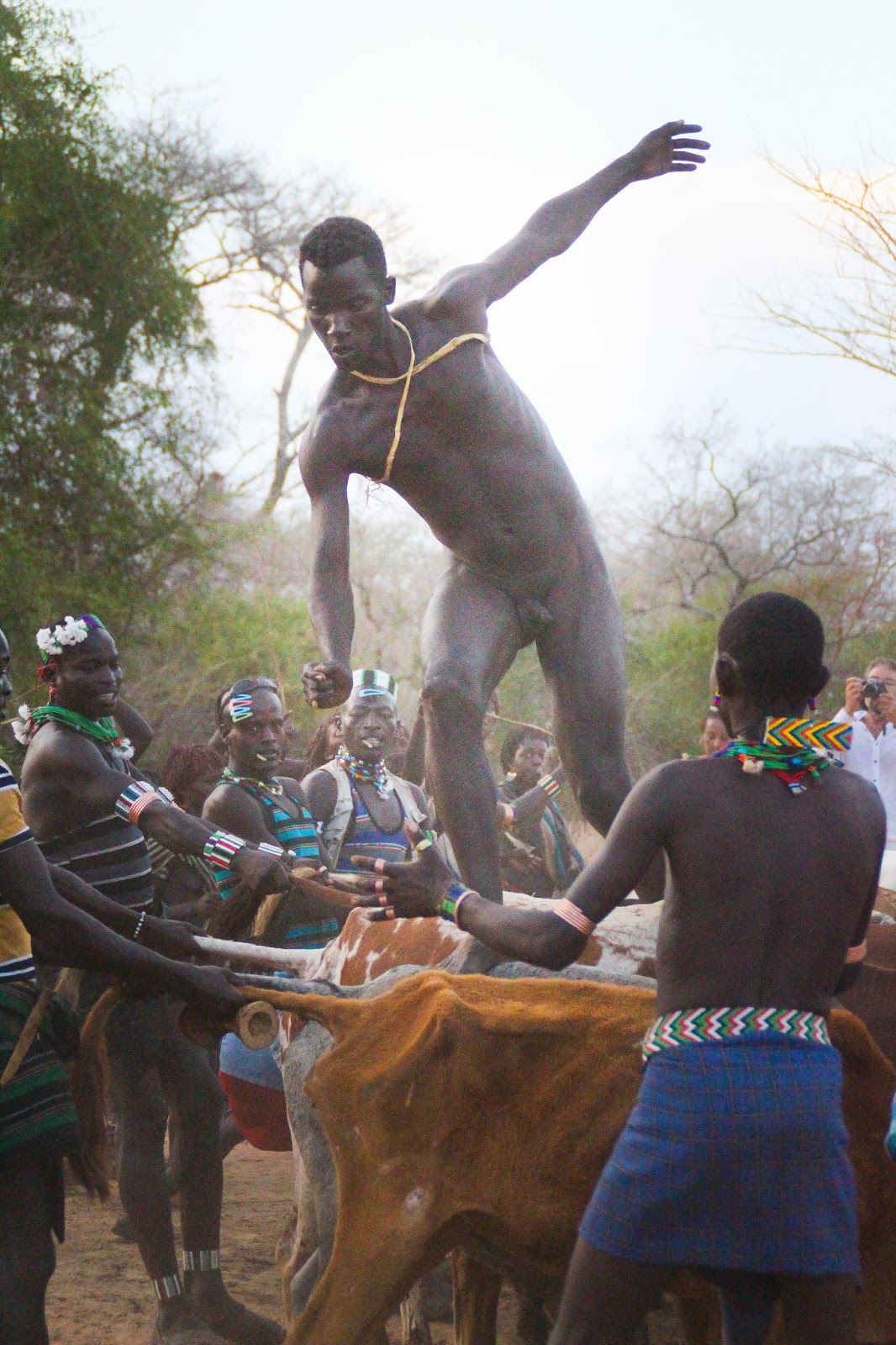
The bulls were pulled into the centre of a tightly-packed circle of people. There, they were jostled into line - shoulder to shoulder, each held in place by its horns and tail. I could see the whites of their eyes from where I was standing. This was the price these beasts had to pay for being such an important part of life here in Omo Valley, where wealth is measured not by money, but by lifestock. A Mursi man, for instance, has to gift thirty-five bulls (and a Kalashnikov rifle, if she has a brother) to his prospective bride's family. Each bull costs the equivalent of four hundred US dollars - so you can see marriage really isn't cheap any where you go in the world!

bena tribe girl with lashes on her back carrying a rifle during the bull-jumping ceremony in omo valley, ethiopia

At a signal, the boy took off - he leaped onto the back of the first bull without difficulty, and the crowded responded with a roar of approval. With full concentration and a noticeable bit of wobbling he sprang from bull to bull. It couldn't have been easy to balance on their knobbly backs. At the end he did an about-turn and came back; this he did a total of four times, before jumping down amongst us again - no longer a boy; now, a man.

bena boy jumping on the back of bulls in omo valley, ethiopia, as part of a coming of age ceremony

Tuesday, March 21, 2017

Simien Mountains, the Grand Canyon of Africa (Ethiopia)

a group of gelada highland baboons feeding on the hillside in simien mountains, ethiopia

On a good day, I imagine the Simien Mountains would be no less impressive than Arizona's Grand Canyon.

We were, unfortunately, not there on a good day.

To be precise, it hadn't even been a good week, according to our guide. Where there was a drought going on in the other parts of Ethiopia, it had been drizzling more or less every day here. It seemed like all the country's rain clouds had descended upon the Simien Mountains and us hapless hikers.

view of canyons and mountains in ethiopia

In a sense this was a welcome relief for those who live here. The drizzle heralded the end of the dry season, washing away the arid dust that hung in the wind and left a strange, scorched smell in our hair. But the downside of this was that the scenery was never fully visible throughout our hike.

view of the surrounding canyons and mountains from our hike in the simien mountains on a foggy day

As we trekked across the mountains, the heavy grey clouds and fog remained our constant companion, obscuring the canyons and cliffs from view. Occasionally - only very occasionally - the sun would emerge and the chill would lift. These moments we cherished; we shrugged off our backpacks and sat with our faces upturned to the sun, revelling in the grandeur of the rugged landscape.

view of a valley from our hike in the simien mountains

In spite of the bleakness, we saw many things:

We saw birds wheeling around a waterfall that plummeted five hundred metres into an abyss below. I teetered on the edge of the cliff - too scared to lean forward, but at the same time eager to catch a glimpse of the waterfall's end - before retreating on wobbly legs to the safety of solid land.

We saw a bomb crater, about three metres across, an innocuous bowl-shaped depression carpeted with grass that had smoothened out its edges. We sidestepped it cautiously as we continued upwards on our hike.

view of the surrounding mountains and canyons from our hike in the simien mountains on a foggy day

We also saw the highland gelada baboons (also called the bleeding-heart baboons, for obvious reasons), stars of their own show on BBC. In the drier months the fresh grass that forms the staple part of their diet is nowhere to be found, so the baboons are reduced to digging for the moist, tender roots of the dried vegetation. The troupe of hundred ignored us as we wandered amongst them on the vast hillside. "You know, they are very fascinating, intelligent animals," our guide marvelled. "They are so much like humans. They have language - or something very close to language as we define it. The adults actually have thirty-seven different types of vocalisations. But the most interesting behaviour of all is that they mourn their dead. They grieve when a baboon dies, and then they drag the body off somewhere - no one knows where, or what they do with the body, but that's why you never see dead baboons lying around."

close-up photo of a gelada highland baboon in the simien mountains in ethiopia


We saw bush bucks prancing at the trail-side; a large flock of guinea fowl in beautiful grey-blue plumage; vultures and eagles swooping overhead.

And we agreed, as we drove back to civilisation, that despite the dreary weather it had been a most pleasant experience after all.

gelada highland baboon feeding on dried grass during winter in the simien mountains in ethiopia
close-up of a gelada highland baboon also known as a bleeding heart baboon in the simien mountains in ethiopia

Sunday, March 12, 2017

Erta Ale's living lava lake


With a last mechanical groan, our four-wheeled drive pulls into base camp. For the past three hours or so we have been forcing our way over the cracked lava fields of northeastern Ethiopia, where more than thirty volcanoes - not all still active - dot the landscape. The going has not been kind to us nor to the rest of our convoy. Thrice we have had to stop to change tires and jump start flat batteries. Now, finally, we are on relatively flat ground and hopeful for some respite.

Base camp is a collection of circular stone huts with roofs of grass, situated on a slight rise. From this vantage point we can see the parched brush and black volcanic sand stretching out for miles around. Sinewy soldiers in weathered uniforms stride around the compound with their AK-47s slung carelessly across their chests. Other than a few sharp commands of "no cameras!", they don't bother to interact with us foreigners. The hostility of the environment is palpable - both within the camp and without.


We're told that the armed guards are necessary because of continuing conflict with Eritrea, a small country in the north that gained independence from Ethiopia in 1991. In 2012, five European tourists were killed. Both sides blamed the other for the attack, and the Ethiopian government has mandated military patrols and escorts in this border region ever since.

After a paltry dinner of canned soup with dry bread, our guide announces that we are going to trek fifteen kilometres across the lava field tonight - so much for rest! Still, I'm looking forward to stretching out my legs after a whole day of bumping around inside a stifling hot car (air-conditioning is non-existent here, even at day-time temperatures well above forty degrees).


The reason we're setting out after dinner is that trekking by night is the most comfortable way of attempting this journey. The Danakil Depression, a desert basin one hundred and twenty-five metres below sea level, is one of the lowest, driest and hottest places on Earth. On top of that, we are aiming to come face-to-face with Erta Ale, an active volcano with a living lava lake (one of only four in the world and the record-holder for the longest one in existence).

By the time dinner is done, the stars have crept overhead. There's a full moon tonight and it's bright enough to see our way around without a torch. Against this brilliant celestial backdrop, someone points into the distance and wonders aloud, "Is that the volcano?" In the direction of his gaze, there is a vivid orange glow on the silhouetted crest of a darkened mountain; it flickers and flares ever so slightly, almost as if by a trick of the eye.


We hike over rock and gravel for three hours. Without any kind of prior agreement, all of us somehow fall into a loose formation - us twenty foreigners walk two or three abreast, flanked by faceless armed soldiers who skirt the edges of our lamplights.

In a way, trekking by night makes the journey a lot more tolerable. It isn't just about escaping the heat; the harshness of the landscape is veiled by darkness, making it easy to focus on each step without thinking about the distance yet uncovered.


Around midnight, we reach a clearing that affords us more space than the ones before. Scattered around are low circular walls made of stacked stones. Our guide gestures at them grandly. "We sleep here tonight," he says. Already thin foam mattresses are being unloaded from the camels and laid out in each of the hollows. Amidst the confusion and general surprise, Dad and I snag a "room" to ourselves.

The two hours of sleep we get are sorely needed but elusive. Partly it's because the stone walls do little to block the wind; mostly it's because of the (unseasonal) rain that starts pelting down on us. With no overhead shelter, we curl up under our windbreakers and try to will away the cold. I suppose from the shuffling noises and muted whispers that no one gets any real sleep. Eventually, the sounds peak and it turns out it's time to start our last hour's trek to the volcano.


From here on the ground changes. The rocks underfoot become increasingly brittle and black, crunching with each step. The guide tells us that these are new lava rocks, barely three weeks old. In places they are so fragile that they cave in with a sudden hollow whuumph, and so we learn to test each footing before placing our whole weight on it. Still, more than one trekker end up with legs shredded from the serrated edges of an unfortunate misstep.

Cautiously, gingerly, we inch across this menacing landscape. Our progress is punctuated with starts and stops as we circumnavigate collapses in the basaltic crust. Everyone is understandably - and some visibly - tense. With my head down in concentration, it's only when I almost walk into the person in front of me that I realise the group has come to a complete stop - we can't go any further, because there is lava flowing out of the ground just ten metres in front of us! 


It is an incredibly surreal experience being able to stand so close to actual, moving lava. One of the movies I remember most from my childhood is Volcano - specifically, the scene where Stan tries to leap over a sheet of lava but fails and lands in it and oh god he bursts into flames and melts into nothing in twenty seconds flat. So okay, naturally I've always thought that lava would be inconceivably hot and you'd get burnt just from standing too close to it, except here I am, ten metres away, and there isn't all that much heat emanating from it. It turns out that watching basaltic lava flowing is more meditative than thrilling. I mean, you can outrun - outwalk, even - the lava. But it's all good, as this gives us all the extremely unique opportunity to observe the lava up close.


All this while, we can see the occasional glow of spurting lava at the other crater pit a few kilometres away. For our safety we aren't allowed to go near that crater as it has been getting increasingly active the past few days, but it doesn't take too much to imagine how beautiful that view must be as well.


In the east the sky brightens; dawn has come, and with that, the blistering African heat. We hasten to pack up and begin our long walk back to base camp. By daylight the landscape looks so inhospitable that I'm astonished we traversed all this way overnight. I don't know if it takes us longer to cover the distance this morning, but it definitely feels like it given that we're functioning on zero sleep and an empty stomach. A thoroughly unforgiving first 48 hours in Ethiopia!